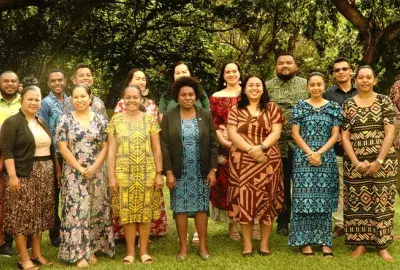
Islands Of Globalization Planning Team

(l-r) Scott Kroeker, Dr. Katerina Teaiwa, Dr. Jerry Finin, Monique Wedderburn,  Dr. Terence Wesley-Smith, 
       Dr. Esther Figueroa


Dr. Jerry Finin, Pacific Islands Development Program, East-West Center

Jerry Finin, Ph.D was born in upstate New York and grew up in the Helderberg mountain village of Rensselaerville. After completing his undergraduate degree in 1978 at the State University of New York at Albany, he joined the Peace Corps and resided in the northern Philippines. In 1982 he entered Cornell University to pursue a degree in Asian Studies and Urban and Regional Planning. In 1986 Jerry was awarded a FLAS fellowship to pursue language and cultural studies at Benares Hindu University in northern India. He subsequently received support from the MacArthur Foundation for extended field study in Philippines’ Cordillera Central highlands. His doctoral dissertation “Regional Consciousness and Administrative Grids: Understanding the Role of Planning in the Philippines’ Gran Cordillera Central” received the Lauriston Sharp Award from Cornell’s Southeast Asia Program. Since coming to the East-West Center in 1990 Jerry’s work has focused on both the Pacific Islands and Southeast Asia. During this time he established the Center’s South Pacific Islands Scholarship Program and served as its administrator for some ten years. In 2003 he was appointed deputy director of the Pacific Islands Development Program. An adjunct faculty member of the University of Hawai‘i he also served as a member of the planning and instructional teams for the University’s Moving Cultures project, a research and instructional endeavor to encourage innovative approaches and remake Asia Pacific area studies. Recent publications include “Artifacts and Afterthoughts of American Colonial Policy: ‘Igorotism,’ Rebellion, and Regional Autonomy in the Cordillera.” in Regional Dynamics of a Philippine Insurgency, Rosanne Rutten and Kit Collier (eds., forthcoming); “Indigenous Institutions for Governance in the Cordillera and Beyond: Requiem or Reappraisal?” in Towards Understanding Peoples of the Cordillera, Lorelei Mendoza (ed.) University of the Philippines Press (2001); “Small is Viable: Tuvalu as a Small Island State.” Pacific Islands Business, July 2001; “Coups, Conflicts and Crises: The New Pacific Way?” Race and Class 42 (4) (Terence Wesley Smith, coauthor). As principal investigator for the Islands of Globalization Project, Jerry is enthusiastic about more closely linking the peoples of Oceania and the Caribbean through research, instructional and outreach activities.


Dr. Esther Figueroa, Juniroa Productions, Inc.

Esther Figueroa, PhD, is a Jamaican who was born and raised in Kingston, Jamaica at the University of the West Indies Mona campus where her father was professor of Education. Figueroa has been a resident of Hawai’i for over 20 years. She has lived and traveled in the Caribbean, Pacific, Europe, North America, Africa and Asia. Figueroa is a writer, media-maker, linguist, and educator. With degrees in History; East Asian Languages and Literatures; and Linguistics, Figueroa has taught, developed curriculum and trained students of all age groups in media through both popular and formal forms of education. In 1985, Figueroa co-founded Juniroa Productions, Inc., a woman-owned, independent media production company dedicated to community empowerment, local content-media and the perpetuation of native cultures. Figueroa has produced numerous documentaries, television series and specials, educational and training videos and multi-media. Her two most recent documentaries are “An Island Invaded” about World War II in Guam based on personal narratives of Guam residents, and “The Salt Song Trail – Bringing Creation Back Together” about the Southern Paiute’s attempts at revitalizing their salt songs as a way of healing and strengthening their communities. Figueroa is a published author in both academic writing and journalism. Her publications include: Sociolinguistic Metatheory (Pergammon 1994). At Home the Green Remains: Caribbean Writing in Honor of John Figueroa (Special Monograph Edition Caribbean Quarterly, Spring 2003). "Whale Rider" Film Review. Journal of the Contemporary Pacific. Fall 2004. And, "Rude Sounds - Kiss Teeth and the Negotiation of the Public Sphere", in Susanne Mühleisen (ed) Politeness and Face in Caribbean Creoles. Benjamins, Amsterdam & Philadelphia. 2005.


Scott Kroeker, Pacific Islands Development Program, East-West Center

Scott Kroeker was born in Winnipeg, Manitoba, Canada and came to Hawai‘i via Saskatchewan (where he spent his very long winters dreaming of sunshine, beaches and palm trees), Bethel College in Newton, Kansas (where he received his BS degree in Business Administration), Hualien, Taiwan (where he taught English and was a DJ in a pub) and Seattle, Washington (where he was an office manager of several environmental organizations). He received his Master's degree in Pacific Islands Studies at the University of Hawai‘i where he was a student assistant helping coordinate the Moving Cultures: Remaking Asia Pacific Studies pilot project in Palau. His master's thesis, entitled "Sechou or Deroech: Local Impacts and Social Responses to Globalization in the Republic of Palau" looked at the ways a small island community is coping with, and taking advantage of, the forces of globalization. He currently serves as the Joint Commercial Commission Project Officer at PIDP responsible for trade and investment issues and website design/maintenance.


Dr. Katerina Teaiwa, Center for Pacific Islands Studies, University of Hawai‘i

Katerina Teaiwa, PhD, is of Banaban, African American and Kiribati descent, born and raised in Fiji. She attended universities in California, Hawai‘i and Canberra and has a PhD in anthropology from the Australian National University. Her research focused on phosphate mining on Banaba and an expanded concept of kainga or "home." She used a multi-sited and multi-media approach to Banaban and Kiribati history and culture and included seven short films on DVD with her dissertation. Her research and teaching interests at the University of Hawai'i include dance and the body, visual studies, culture and consumption, theory and method for Pacific Islands Studies, feminist ethnography and popular culture. She is mainly interested in exploring the ways in which islanders in both the Caribbean and Pacific creatively negotiate, resist or employ regional and global art forms, ideas and technologies for survival


Ms. Monique Wedderburn, Pacific Islands Development Program, East-West Center

Monique Wedderburn, a native of Barbados and Belize, grew up around the world in Texcoco, Mexico, Zaire, Africa (currently the Democratic Republic of Congo), Islamabad, Pakistan and Bangkok, Thailand. Ms. Wedderburn holds a B.S. degree in business administration from Colorado State University and an MBA from University of Hawaii at Manoa. Her professional experience is comprised of a range of experiences. Ms. Wedderburn formerly managed the University of Florida Physical Plant Career Development Program and as a business analyst worked on economic development and business plans at the University of Hawai‘i's Pacific Business Center Program. In her tenure as an economic development island fellow for the U.S. Department of Interior’s Office of Insular Affairs in Summer 2004, she focused on building business partnerships in the US Virgin Islands. Ms. Wedderburn, currently completing a selective leadership program with the East West Center (EWC), works as a Student Fellow with the Pacific Islands Development Program on the Islands of Globalization Project. Her area of interest is in international development and organizations that are dedicated to the alleviation of poverty. 


Dr. Terence Wesley-Smith, Center for Pacific Islands Studies, University of Hawai‘i

Terence Wesley-Smith, PhD, was born in Cork, Ireland, and lived in Aotearoa/New Zealand for eight years before coming to Hawai‘i in 1981. He earned an honors degree in political science and international relations from Victoria University of Wellington, where he was teaching assistant and studied self-determination movements in the Pacific. He came to Hawai‘i as an East-West Center grantee and completed a PhD in Political Science at the University of Hawai‘i at Manoa. His doctoral dissertation “Melanesians and Modes of Production: Underdevelopment in Papua New Guinea with Particular Reference to the Role of Mining Capital” was based on research on the island of Bougainville. Since 1985 Dr Wesley-Smith has taught at the Center for Pacific Islands Studies, where he is currently Graduate Chair and Associate Editor of the Center’s journal, The Contemporary Pacific. Since 1997 he has directed Moving Cultures, a Ford-funded research and instructional project to encourage innovative approaches to Asia Pacific area studies. His recent publications include “Net Gains: Pacific Studies in Cyberspace” (The Contemporary Pacific 15(1), 2003), “The Ocean in Me: Personal Journeys in Pacific Studies” (Brij Lal, editor, Pacific Places, Pacific History, UH Press, forthcoming), and “Coups, Conflicts and Crises: The New Pacific Way?” (with Gerard Finin, Race and Class 42(2), 2001). Terence Wesley-Smith is interested in using web-based technologies to link university classrooms in the Pacific and Caribbean to discuss common experiences with globalization.

Homepage

IOG To Attend 2005 Caribbean Studies Association Conference

Call For Papers

Featured Speaker: Cassandra Pybus - Black Refugees of the American Revolution

Learning Islands Workshop [Final Report now available]

Fall Festival of Writers [Audio Files Now Online]

Islands of Globalization Graduate Seminar (Spring 2006)

Film Series

Working Bibliography

Links

Maps